

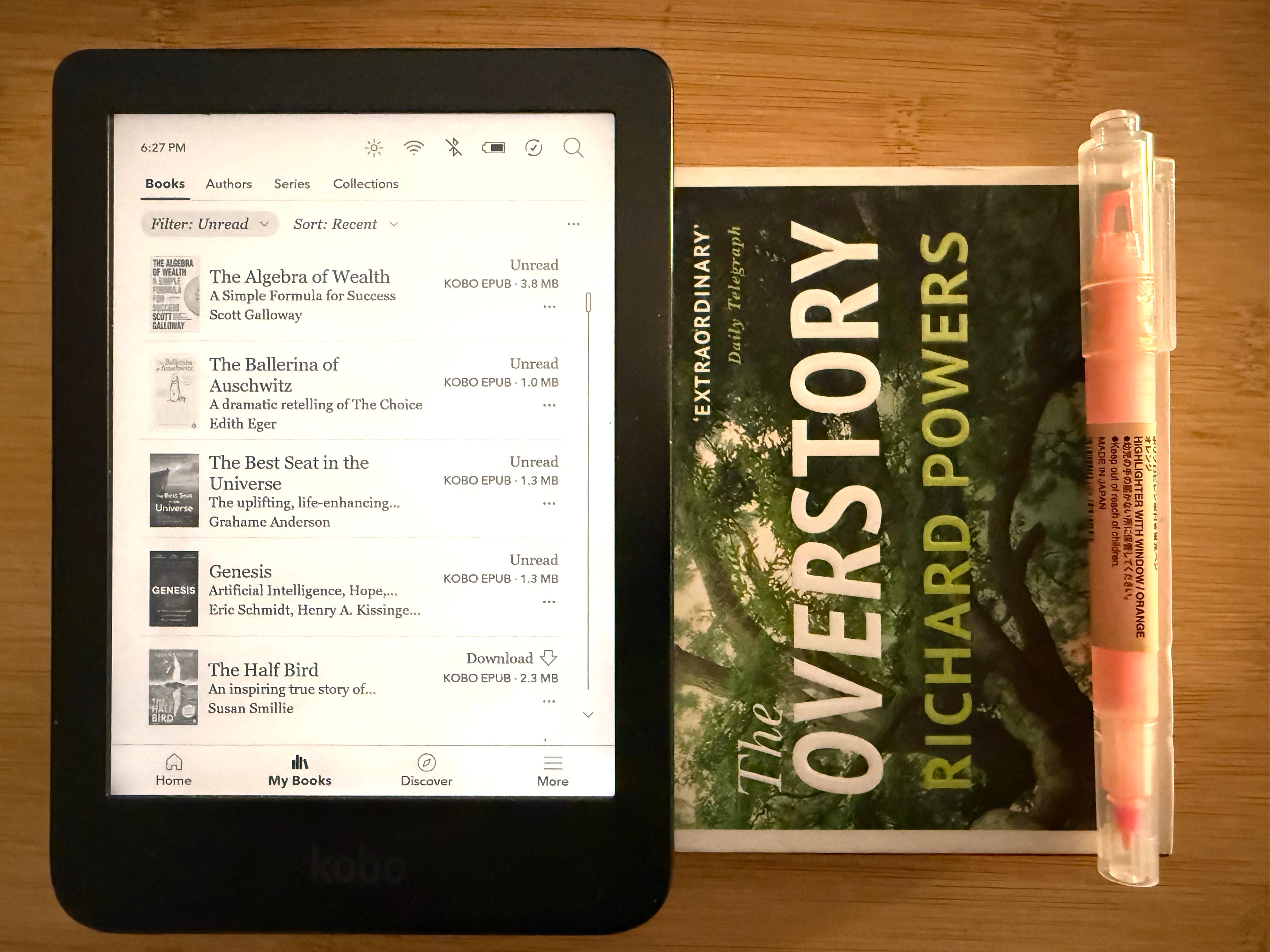
TLDR; eBooks are cheaper, easier to buy, hold, carry, read and highlight. Paper books smell nice, look cool and remind us of simpler times. YMMV.
As an avid reader and book lover, I’ve been obsessed with the paper versus eBook debate for at least 20 years now. I’ve read countless opinion pieces, watched dozens of Youtube videos, read through quasi-religious debates on Reddit and personally flip-flopped between both options for decades without being able to fully commit to either one.
This article has been years in the making. I’ve been noting down arguments in favour of each option as I alternate between them and as my reading habits develop.
I think I now have the definitive list of pros and cons.
For context, I read mainly non-fiction, about a book a week. I read maybe 2-3 fiction books a year as well. I do also listen to the odd audiobook, although not as many as I used to - I don’t feel I get that much out of them due to the difficulty of note taking and highlighting.
I won’t go into too much detail here about my ‘workflow’ (it pains me to admit I even have one). Suffice to say that I do highlight and I do use digital tools to review, store and retrieve those highlights. I’m not a ‘professional’ reader. My career doesn’t depend on the efficiency of my reading and/or note taking, but I consider myself more than just a ‘casual’ reader.
That said, here’s what I consider to be an exhaustive, verging on neurotic, examination of the pros and cons of both formats. If I’ve missed anything, please let me know.
Reading Comfort
The physical part of processing printed words and sentences into abstract thought is actually quite a holistic exercise, involving eyes, head, neck, shoulders and arms. The standard way of reading a book, which applies to both electronic and paper, is sitting or lying with the book held out a certain distance in front of your face as you parse the words on the page. eBooks, at least the smaller ones, are easier and more comfortable to hold, especially when either lying down or sitting in more awkward positions.
Physical books have to be held open at the current page, which means either holding with two hands or doing the thumb trick to keep the two-page spread flat, which gets tiring after a while; this is compounded by the fact that paper books are bulkier and heavier. Ebooks can usually be held in one hand for long periods of time pretty easily, either by wrapping your palm around the whole unit, or pinching the border around the screen. You can even add one of those loop attachments to the back of an eReader to make it almost impossible to drop.
Ebooks are also better in terms of visual ergonomics. Screens, in general, are usually not much fun to stare at for protracted lengths of time, but modern eReaders have superb high-contrast screens with incredible resolutions. Long gone are the days when printed books were the better option in terms of print quality; in fact, a lot of books these days seem to be printed on flimsy paper with a nasty beige hue that considerably decreases contrast. To better contrast and resolution, also add built-in backlights, variable fonts and adjustable text size. To serious readers these are far from gimmicks. Built-in backlights are not only, or even mainly, useful for avoiding disturbing your other half whilst reading in bed - which is how they are usually advertised. Good, modern backlights make for better reading contrasts in almost all circumstances. If you’ve ever tried adjusting an external reading light for comfort, you’ll know how hard it is. If you shine the light directly at the screen you get a blinding glare, but if you point it away, it normally doesn’t provide enough light. You want a comfortable diffused glow, which is exactly what a backlight gives. Most modern eReaders have variable light temperature too, so you can switch to a warmer hue in the evening - perfect for pre-sleep reading.
Variable font and text size is invaluable for two reasons. Most importantly, it allows a lot of us who would otherwise require them to read without glasses. One less accoutrement to tote is a big boon (more on this later) and plays on my desire for minimalism. A side benefit, and applicable even if you don’t use glasses, is that you can adjust font size for legibility at different distances from your eyes, which means you can optimise holding distance and therefore arm and shoulder comfort. These small wins add up over hours, weeks, months and years of reading.
Convenience
Ebooks are more convenient to hold and read, but they are also more convenient to carry around. I think that trio of conveniences is what explains eBook popularity amongst travellers.
An eReader is a fraction of the size of just a single physical book but it can store hundreds or even thousands of editions. The ability to carry your whole library in the back pocket of your jeans is a major win for eBooks, especially when attempting to travel light. It might not make much difference if you only read in the comfort of your own home, but for reading whilst out and about or on longer trips, it’s a no brainer. Imagine backpacking through the mountains for a few weeks with enough books to tide you over and paying almost zero weight penalty. That’s only really feasible with eBooks.
Of course, you’ll need somewhere to charge your eReader though. Physical books don’t need charging, so that won’t be a problem. Having said that, this is less and less of a problem as battery technology and software efficiency get better. My eReader goes for weeks without needing charging - enough to get through an extended trip. Modern examples use USB-C charging ports so the likelihood you’ll have a charger handy is also very high. I’m normally bothered by the need to charge devices - I don’t like the dependance it creates - but it has to be said that once charging frequency falls below a certain threshold, it just doesn’t feel problematic any more.
I mentioned that you might not need your glasses for eBook reading; there are other areas in which eBooks win in terms of accessories not needed.
If you’re like me and use a pen for highlighting, that’s something you need to consider when reading a paper book. I’m yet to find a system I like for attaching a pen to a book. I know there are sticky pen loops you can buy, but I don’t want to have to mess around setting that up each time I start a new book. I’ve also experimented with elastic pen-holder cases and even carrying books in a case which has a little side pocket for pens, but ultimately I found neither convenient. Highlighting eBooks with either just your finger or a stylus which attaches magnetically I have found to be both pleasing and easy.
Bookmarks I’ve never really liked. When I start a book I can never find one handy, so I end up using a piece of toilet paper or a photo of an ugly baby. When reading outside they always get blown away, which is why our pool skimmer was always blocked by photos of ugly babies. Unsurprising that I love eBooks ability to mark a page with zero effort. I also like that fact that you can have multiple bookmarks without employing multiple photos of ugly babies. Probably worth noting here that electronic bookmarks are great until they fail for some reason (like multi-device syncing), at which point you have no idea where you are in the book; honestly though, physical bookmarks are also prone to falling out so that’s a draw.
Multi-device syncing is actually another, often overlooked, benefit of eBooks. I have a Kobo, which has an iOS app and website, both of which allow reading. I wouldn’t consider either of those a primary medium, but they can be used in a pinch if I don’t have my eReader on md (e.g. waiting at the dentist, on the train, at my desk on a lunchbreak). For a time I also had two Kobos, which is a great option. I had one upstairs in the bedroom and one in the lounge, which meant I could easily pick up reading the same book at any time. Lazy? Yes, but where reading is concerned, anything that can reduce friction is to be embraced.
PKM (Personal Knowledge Managment)
If you’re not a nerd, you probably won’t know or care about this stuff. PKM is taking reading a bit further by trying to extract, process, retain and use knowledge from books. Everyone takes it to a different level, so everyone’s requirements and opinions are different. This will probably be the most subjective section.
‘Reading stats’ are much harder to collate and track with paper books. If you’re using an eReader you’ll automatically have access to lots of different facts and figures, like reading volume, speed and when you started and finished all your books. This may seem minor, but it can be very useful. For example, when writing my article 2025 in books, I used this feature to easily see everything I read this year.
Highlighting is a big deal in PKM. I highlight and collect my highlights using Readwise, which is a pretty common workflow amongst PKM geeks. It’s definitely possible for both eBooks and paper books, but the process is quicker and more efficient with eBooks. With paper books I have to have a pen at hand and usually fold down the corners of pages where I’ve made a highlight so I can ‘process’ the book quicker once I’ve finished. I’ve tried little sticky tabs and suchlike, but having to have yet more accessories with me when I want to read is just too much friction. Folding corners works quite well, although it does make a mess of the book. You’ll also need to consider whether physically marking a book is even an option for you. Obviously if the book is not yours then it won’t be, but even if you are the owner, you might not want to make permanent physical markings like highlights. You might just consider it ugly, or you might think that it makes it impossible to lend or sell the book later. Personally, I quite like butchering books (more on that later) and also love lending (and borrowing) ‘personalised’ books. Obviously none of this applies to eBooks where you just swipe across the sentence with your finger and the magic pixels do the rest.
Collecting up highlights post-reading is easier with eBooks, although that’s not always considered a pro. I’ve heard it argued that being forced to revisit highlights a short time after finishing a book can aid retention, but personally I don’t really enjoy processing highlights and try to do it as quickly as possible. I don’t believe I really reread them, so don’t subscribe to this argument, at least for my personal use case. The Readwise app has a pretty efficient flow for adding highlights from physical books via the camera. I like it and use it, but have to admit that it’s a pain and I put it off as long as I possibly can. For eBooks, there’s nothing to do - Readwise automatically syncs highlights without any user intervention, which is really nice.
Beyond highlighting, you might, like me, enjoy ‘active’ reading (aka butchering books in a way your mum told you never to do). If you’ve never tried active reading, I strongly recommend you do. Active reading means reading with pen in hand. It means writing down thoughts in the margin, questions, exclamation marks and smiley faces. It makes reading a more interactive process and stops you falling asleep so readily. Active reading with eBooks is mostly crap. I say mostly because I think some of the new eReaders support a better in-book writing experience with decent styluses, but nothing beats a paper book if you want to read actively and write in it, for at least four reasons.
Firstly, paper books have blank pages at the front and back, which are useful places to make more extensive notes, lists of topics, new vocabulary etc. If you’re reading an eBook you either have to have a separate notebook to hand, which is inconvenient, or switch to the notepad function of the eReader (if it has one), which in my experience is slow and clunky.
Secondly, to truly interact with a book you often end up quickly flicking back and forward to reexamine previous points and check current context, sometimes referring right back to the contents and navigating to different chapters. This is slow and awkward with an eBook, rendering such a reading style almost impossible.
Thirdly, eReader styluses, at least at this point, still aren’t as good as real pens. Granted they are getting better, and it’s certainly true that e-ink tablets (as apposed to eReaders) are getting very good styluses, but paper still beats screen here, at least for me, at least in 2025.
Lastly, eReaders and reading apps differ widely in how they implement free writing on eBook pages. Incidentally this is not an insignificant technical challenge due to the ability to change fonts and text size on the fly. Some, therefore, don’t allow it at all, others have you write in a little box, others allow you to write anywhere but then stop you changing font size. It’s a mixed bag.
Purchasing Books and Cost
To state the obvious, with both eBooks and paper books you have to pay for each book. Only eReaders, however, involve an upfront cost. For most serious readers (and if you’ve got this far, I’m guessing that’s what you are), the initial investment for a basic eReader is fairly negligible once amortised across its useful lifetime, which is likely to run into the multiple hundreds of books read.
Ebooks are cheaper than paper books. They should be a lot cheaper given the savings on physical material and distribution, but I guess we’re supposed to believe that the principle thing we’re paying for is an intangible intellectual good with the majority going to the author, so we won’t get into that debate. I’m finding that physical books are getting more and more expensive whereas eBooks seem to be on an opposite trajectory. I keep an eye on the Kobo ‘Sale’ page and am regularly able to pick up great books for £1. That’s rarely possible with new paper books, although of course there are other ways to procure paper books (charity shops, garage sales, friends) that aren’t possible with eBooks - we’ll come onto that shortly.
A serious, perhaps even decisive, factor for me is availability. I live abroad and the only place I can purchase English-language physical books is through Amazon. Not only would I rather not give Amazon my money, but I get the feeling that most of them are print-on-demand, as the quality of the paper, cover and binding is often really poor. Ebooks are a great solution to this problem for me, and expats in a similar situation, but I understand it won’t apply to everyone. Having said that, nothing beats the immediacy of eBook purchasing. The ability to have the urge to read something and to be able to have the book in your hands in under 30 seconds is another of those friction-removing qualities of eBooks that I really appreciate. I read best when I’m highly motivated and inspired to explore something I’ve just discovered. That motivation and inspiration tends to fade quite quickly if not nurtured.
There are some other minor conveniences around purchasing eBooks which are hard to replicate with paper. For example, both Kobo and Amazon allow you to maintain wishlists. A book on your wishlist can be purchased with a couple of clicks. Whilst you can always maintain your own lists of paper books you’d like to buy and then go and get them in store, the process is somewhat less seamless.
Digital Rights and Privacy
When you ‘buy’ an eBook you don’t really own it, at least not in the normal sense of the word. Depending on your eBook platform of choice, it will be some sort of Frankenstein rental-like contract which binds you to a series of conditions which look nothing like ownership (see It’s Their Content, You’re Just Licensing It from The New York Times for a deeper dive). You won’t be allowed to resell, lend, duplicate, read on third-party devices or maybe even download a file at all. To some extent, the platform even controls your access to the media and there are (admittedly few) examples of books being ‘withdrawn’ from sellers’ platforms for whatever reason, meaning previous purchases can no longer even access the title which they supposedly own. Amazon’s removal of 1984 and Animal Farm from Kindle comes to mind (although, to be fair, they did refund buyers).
You might not care about these digital shackles, or you might have the patience and technical knowhow to employ software to circumvent DRM restrictions and ‘jailbreak’ your eBook files, but it’s a pain and something you shouldn’t have to do if you’ve just shelled out £10 for a book. There are also sources of DRM-free eBooks (Defective by Design is a great place to start) but these tend to be older, copyright-free or niche titles; new, mainstream publications are always DRM restricted.
There’s a deep ethical argument around property rights here, but there’s a practical element too. Personally, I don’t think I’ve ever sold a book, but I have often lent my favourite titles to friends and family. There’s something satisfying to me in not just recommending a book, but being able to wonder up to your bookshelf, find your dog-eared copy and lend it to someone.
Paper books are yours, full stop. Aside from a few marginal activities, you can basically do whatever you want with them. You are never going to get that level of ownership with eBooks. There is, admittedly, a flip side to this. Once you take ownership of a paper book, it’s your responsibility to take care of it. If it gets left on the train, burnt in a fire or destroyed in a flood, it’s gone for good. Ebooks are sort of on deposit and can be redownloaded at will; it’s like having your books in the bank. Paper books are also subject to wear and tear and can eventually yellow and fall apart, a process which obviously doesn’t affect their digital counterparts. Again, you have to view this in the context of platform permanence and potential changes to conditions, but it’s worth taking into account. My feeling is that current eBook platforms will probably disappear before any paper book I own disintegrates.
There are serious privacy and platform issues with eBooks that might turn you off, depending on how sensitive you are to these types of issues. Assuming you want to have the option of purchasing new releases and recent back catalogue books, there are only a handful of realistic platform options to choose from, as opposed to hundreds of options for purchasing physical books - from Amazon all the way down to your local bookseller. For eBooks, last time I looked, the only real choices were Amazon (Kindle) and Rakuten (Kobo). Whichever way you go that means platform lock in: once you start buying books on a particular platform, your sunk costs grow and it becomes ever more burdensome to switch. This is, of course, a non issue with physical books. The digital format also lends itself nicely (from their point of view) to platform overreach. To some extent they will spy on you and try to advertise to you: those nice, free cloud features like syncing and recommendations are paid for with your privacy. Like it or lump it.
Environment and Minimalism
We haven’t touched on the environmental arguments yet, because it’s an absolute minefield and you can probably make the evidence support whichever conclusion you prefer. It’s only a realistic contest for heavy readers; buying an eReader and using it a couple of times is clearly worse for the environment than just buying those few paper books. The evidence seems to suggest that the ‘breakeven point’ (the point at which the environmental toll of consuming paper books outweighs the big upfront toll of the production of the eReader) is somewhere between 13 and 30 - see Pierre-Olivier Roy’s superb The environmental footprint of paper vs. electronic books for a more detailed breakdown. In summary, for serious readers, eBooks are probably the more environmental option.
A related argument, and one that appeals to me personally, is that of minimalism. Buying physical books means accumulating more stuff with the concomitant necessity to store it, dust it and take it with you when you move. I did this recently and moving books is an absolute pig. Amassing big collections of objects is one of the least minimalist things you can do, whereas a single device with a thousand books on it strikes me as fantastically minimalist - my whole book collection in the palm of my hand.
The only argument that really matters
Paper books are just cooler. Their musty, woody scent reminds us of a simpler time, a time without screens, distractions, cloud platforms and surveillance. Shelves full of books make you look intelligent and are great backdrops for zoom calls. When you sit and read a real book you feel like a philosopher; more importantly you look like one. Sit in a cafe with an eReader and you won’t get a second glance. Sit reading a real book and people will look at it, maybe even strike up a conversation. In a world that’s rapidly replacing everything with vapid digital equivalents, a real book is a statement. An eReader is just another device.
Me
So where do I stand? Reading this back, I definitely sound like an eBook fanboy, and in some ways I am. I really want to just commit to eBooks and have done with it. I prefer the casual reading experience, the lower cost and the immediacy of being able to grab whatever book I want, whenever I want (and not having to buy from Amazon). I go through long periods of only reading eBooks, but gradually the yearning for paper comes back and I end up ordering a sackful or getting relatives to bring a large stockpile over from the UK when they come to visit.
The urge to return to the comfortable and familiar paper medium tends to creep up on me for one of two reasons:
1) If I’m on a dedegitalisation kick and am sick of screens, devices, charging and cloud platform privacy-invasion.
2) I’m going through a period of reading denser, more philosophical texts and want to scribble all over them, and/or more textbook like books with pictures, figures and complex layouts which are easier to deal with on paper.
Eventually these phases tend to wear off and I’ll go back to eBooks for a while. I’ve been in this rhythm for years and can’t see it changing any time soon.
Sometimes I try to come up with a way to formalise the split by assigning different types of reading to different mediums. As mentioned, textbooks and reference material almost always work better on paper. On the contrary, for the little fiction I do read, I don’t see the advantage of paper; in fact, given that I’m more likely to read in bed and don’t need to highlight, the more comfortable form factor and backlight of the eReader work better.
There are a couple of possible future scenarios that might push me completely over the edge either way. If the ‘perfect’ eReader device came along, I might be tempted to ditch paper books altogether. I realise this will likely never happen but it would look something like this: a DRM-free, open-source, repairable device with a silky-smooth writing/highlighting experience, a backlight, no platform lock-in and a fair and ethical digital ownership model.
The more likely scenario is that eBook platforms move towards ever more exploitative revenue models, devices get less robust and long lasting and I end up back where I started, with good, old paper books.
One small benefit of ebook stores you didn't mention is a trail / demo couple of chapters. I find this is pretty useful. I'm not *so* bothered about spending £10 on a book I ultimately dislike, I'm more concerned about knowing when to give up on a book that I should. When I'm forced to actually buy the book to continue that's a great place to possibly quit on the book, that I'd likely not take if I'd bought the physical copy of the book. I'm generally bad for finishing books I should give up on.
Personally I'm usually surprised by how little of the book is a trial. If I were an author I would want at least half of the book available for free. If I haven't convinced the reader to pay for the rest of the book within the first half, then it's probably correct that they don't have to pay for the first half. Also, the more you've read, I suspect, the more likely you are to pay to finish it, sunk cost and all that.
Obviously, I am not your target audience for this particular essay, but I really did enjoy it; as a non-reader of ‘e’ or anything else I have no opinion of the best way to read and I’m so jealous that you are such an avid reader. I’d like to think I had something to do with that, but I don’t think reading Mr. Men books to you when you were 3 had a bearing on it!!