

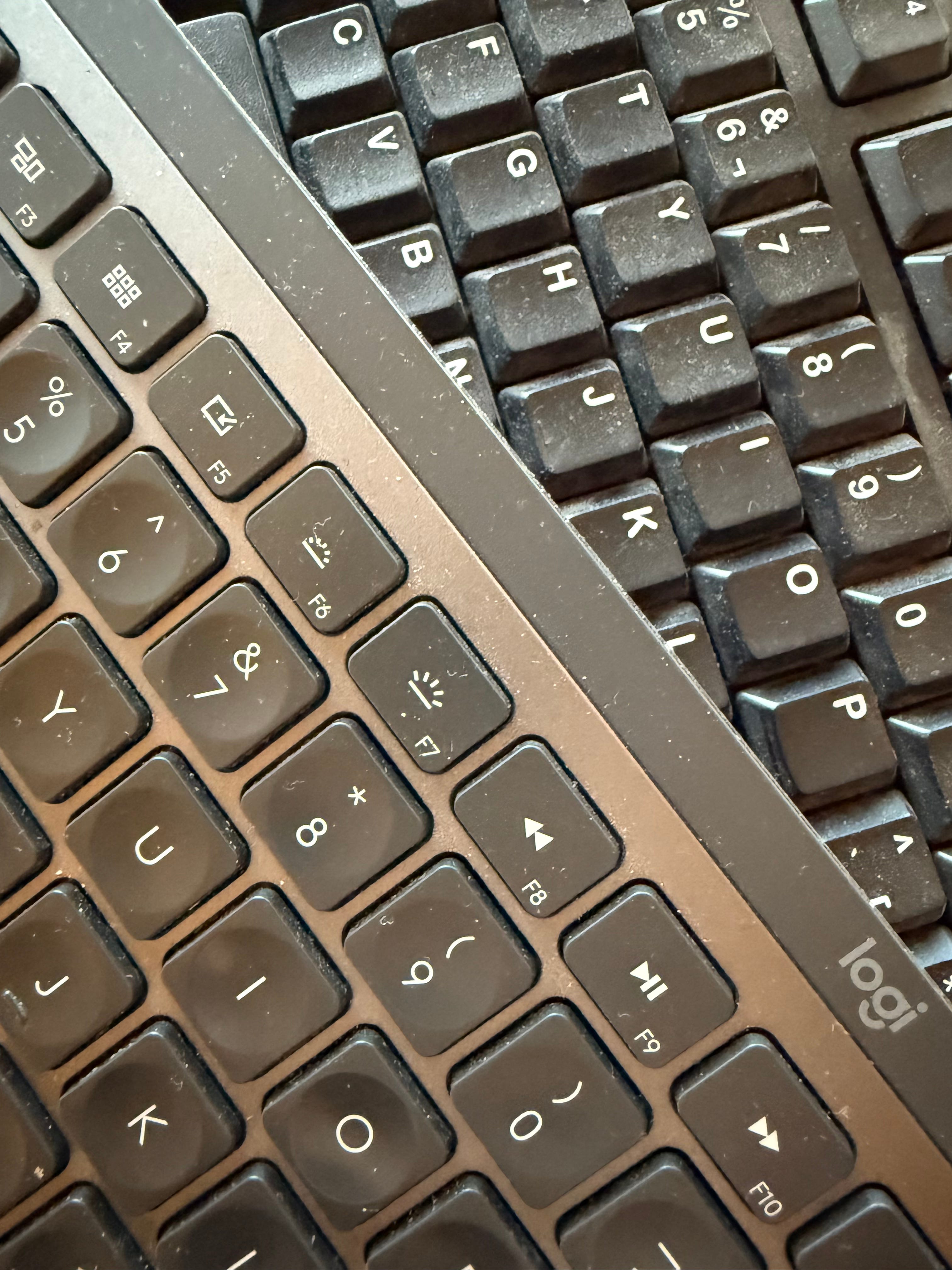
This is the question I'm currently asking myself as I sit on the floor, surrounded by a decade of digital detritus.
Seriously, how many backup keyboards are actually enough? I'm not talking about the keyboards we currently use (one British, with the pound sign, one Spanish, with the 'n' with the squiggle on top); I'm talking about the ones that live unused in a box marked (mentally) "Gadgets that I am not currently using but may one day need to fall back on".
I sometimes seriously wonder exactly how many neurons that label is taking up in my brain. Not just the label, but its association to that particular box that functions as a digital junkyard. For ten years I've had to remember that that bloody box is where the broken headphones, 8-year-old router and said keyboards are. Sometimes my grey matter fails me and I pull out the box next to it. Sometimes it takes me 2 or 3 goes. I could, of course, have just labelled the damn box ten years ago - but I didn't. Probably a good thing though as that box has lived other, equally unglamorous lives. Once it contained about 300 CDs, back when they were a thing. Oh, they are a thing again now are they? I struggle to keep up. I must admit, I sometimes have dark feelings towards the box. Sometimes, like now, I want to smash the contents into tiny shards with the massive sledgehammer thing I have in the shed. Or is it behind the shed?
I digress. Back to the keyboards. We have six spare: four British, two Spanish. There are also four mice. And a trackpad. I know this is too many, but how many to get rid of? Whole minutes go by as I deliberate. I can't easily offload the British ones here in Spain, so they will have to stay. I opt to donate a keyboard and mouse set that is only slightly stained with battery acid. Another (the source of the battery acid) is in such a state it goes straight in the bin. So I'm now down to four spare keyboards, which I figure is probably enough.
How the hell did I end up with so many keyboards? That's a fair question. I'd love to say I know the answer, but their origin story remains a mystery to me - like the booklet stapler, 7-hole punch, roll of thermal labels and barcode scanner that live in the next box along - the one marked (mentally) "Stationery, or stationery-like implements that I have not used for more than 5 years but might be useful one day should I decide to distribute propaganda and/or open a small grocery store".
So much junk. So much mental baggage. So much waste.
Truth is, we've both been doing this for days. Keyboard proliferation is not even the worst of it. How many hair waxes does one need? I have seven tubs: matte paste, high gloss jelly, paste wax, wax jelly, clay (!), beeswax and crème (whatever the fuck that is). Some of the pots are in English, which means they are more than 15 years old. Oh what hospital visits I could enjoy if I slapped on some of the yellowing goo. If only I still had a decent head of hair on which to use it. Perhaps I secretly believe that the 5% oxywhatever shampoo that is sitting, unused, next to the hair waxes is somehow going to restore my majestic mane.
So here we are, suddenly required to wind up a decade or more of a life lived in these four walls. At times I feel disgusted and other times ashamed at the amount of crap I've accumulated. I'm not a hoarder or a collector, and I've been constantly cleaning out, donating and selling stuff over the last decade. I am a legend on the local second-hand marketplace app. When I leave this place, I expect the local post office may have to lay off staff. "I think he's gone", they'll whisper on their tea break. You laugh, but when my old dad passed away, the girls from the local post office came to his funeral. Like father, like son.
For the last few years I've been pleading with friends and family not to buy presents or bring more junk into the house when they visit. Everyone knows the rule. Only books. Yet the aftershave still comes. I hate aftershave. I don't want to smell like a travelling salesman. I give my relatives two or three bottles every time they visit. Mind you, these are aftershaves they gifted me in the first place. There are ones they don't like and won't take back so I spray those under my armpits if I'm feeling special of a weekday morning.
We do the same little dance with wine with the neighbours. We host a dinner. People bring wine. We put it downstairs. It sits for six months. We go to their house for dinner. We take the wine back.
We humans, we're not meant to live like this, drowning in plastic shit and little bottles of ointment. When we led nomadic lives, moving from camp to camp as the seasons and local resources waxed and waned, we could only keep and transport the bare minimum: bows, arrows, a few stone tools and something to cover up your penis. Covering your arse was only invented with the agricultural revolution and henceforth pants took over the world (18 pairs, only 2 without holes, in case you were wondering). In Sapiens, his biopic of human history, Yuval Noah Harari puts it like this:
"We hardly notice how ubiquitous our stuff is until we have to move it to a new house. Foragers moved house every month, every week, and sometimes even every day, toting whatever they had on their backs…They consequently had to make do with only the most essential possessions. It's reasonable to presume, then, that the greater part of their mental, religious and emotional lives was conducted without the help of artefacts."
It should be stressed that there is no broad agreement in anthropology as to the nature or origin of what we would now refer to as 'private property', but a common argument is one that links the emergence or existence of personal dominion over artefacts to the notion of the sacred. Referring to musical instruments like trumpets and flutes, Graeber and Wengrow in The Dawn of Everything note that "these sacred items are, in many cases, the only important and exclusive forms of property that exist in societies where personal autonomy is taken to be a paramount value, or what we may call free societies."
We might summarise, then, that:
Early humans probably had few private possessions.
Those they did have were symbolic and sacred, rather than utilitarian.
Somewhat counterintuitively, this lack of possessions existed in a framework of maximal personal freedom.
With that in mind, I don't think it's any wonder that modern humans buy little jaunty pins with which to accessorise clogs. If private property was sacred and hard-to-come-by, we probably have something of a hardwired desire for it, right next to the circuitry that drives us to consume vast quantities of salt, fat and sugar. We end up physically and materially obese.
For the last 10 years I've been experimenting with a lot of hobbies and a lot of tech and that has necessitated what I always refer to as 'frictional costs'. I wouldn't shy away from buying a synth or a computer because I knew I could sell it a few months later, at an acceptable loss, if it didn't work out. To me, that loss was akin to what it would have cost to rent the item for the trial period, which of course is rarely an option. I always thought it was a pretty good system. Now though, as I lug a full bag of old instruction manuals down to the recycling point, I'm not so sure. I haven't consulted a physical instruction manual in over a decade, yet I've kept the booklets for seven generations of hair trimmers. I believe one of them might even be for a nasal trimmer.
Our new place is going to be smaller, about a third of the size. I'm also in a different place in my life now. I think I finally understand just how destructive this consumerism really can be.
I really, really don't want to do this any more. It's not just the wasted money - it's everything. Moving it, cleaning it, storing it, maintaining it, learning how to use it, selling it, disposing of it. I don't want the 'headphones, sport' to be on the ground floor, the 'headphones, non-sport' to be in the office, and the 'headphones, Apple, Lightning connector (obsolete)' to be in a little metal box, inside a bigger plastic box, on a shelf, in a desk, on the top floor.
What you pay for material goods is not just the price on the ticket-
it's the neural capacity lost to internalising the classification system of drawers in the hallway. You can buy those dividers from IKEA, but you're still the one that has remember what goes in each of the eight compartments, lest disaster strike and the keyrings end up with the stamps.
All this crap - it takes up mental, not just physical, space. I'm left wondering which way round the relationship goes: do I own this stuff or does it own me? And I'm haunted by Tracy Chapman's lyrics:
Consume more than you need / This is the dream
Make you pauper / Or make you queen
I won't die lonely / I'll have it all prearranged
A grave that's deep and wide enough
For me and all my mountains o' things