

Plans for our new house are now progressing nicely, whilst we remain shacked up in Felisa’s house, which is working out great. Jess is spending all her time pinging between architects, constructors, surveyors, technical engineers and suppliers. Right now we’re down to the nitty gritty of floor insulation thickness and ceiling heights. She’s worried our design, essentially a big empty barn, will have disproportionally high ceilings.
We cleared our plot in the summer, but we’ve been noticing it gradually turning back into a rubbish dump as the months pass and it lays empty. Yesterday Jess saw a load of orange paint buckets in the corner and as we discussed it over dinner, Felisa sheepishly admitted that they were hers.
“Why the hell are you hoarding paint buckets?”
“I was hoping the rain would soften the paint so I can clean them up”.
“What do you need buckets for?”
“To collect rainwater”.
“Why do you collect rainwater?”
“To mop the floor”.
Felisa has an outside tap, but it’s at waist level and above a sink, so she can’t get a bucket under it. Even is she could, there’d be no way she could lift it down to the floor. Her ingenious solution is to just let nature do the work for her. She then transfers the rainwater to the mop bucket with an old tuna tin that I’ve been seeing around the garden for 20 years without ever realising it was a key implement in her water recycling system.
The village folk, especially the elders, are ingenious beyond anything I can fathom. They’ve had to make do with so little, for so long, that anything they can get their hands on is valuable and can be repurposed. Whereas we rely on book knowledge and throwing money at problems, they solve them with our trash. The paint buckets were being thrown away by Ricardo, which is how they ended up in the corner of our plot.
The downside of this is that when resources grew more abundant as the 20th century caught up with the village, Felisa and Arturo never stopped hoarding. When we cleared our plot, which had been their vegetable patch and general storage area, I threw away a full sack of 30-year old corn-on-the-cobs that Arturo had been keeping as fire starters as well as 13 brooms, handmade from twigs and bound with hey-bale string.
The house we’re living in, Felisa’s house, was built by her late husband Arturo, Jessi’s grandfather, a really, really long time ago, before they even got married. I call Felisa over and ask her which year the house was built. She tells me to wait, gets a pen, and starts doing maths in the corner of a crossword puzzle book. The equation looks like this: Arturo was born in 1928 and he was 27 when they got married. He had built the house 4 years before they tied the knot. Without so much as a calculator or even carrying a one, she was able to tell me the house was built in 1954 - 71 years ago.
Arturo was as ingenious as Felisa. I once witnessed him and an 80-year-old friend put up a wooden floor (not the floor covering, the actual floor structure) by sitting precariously on the beams with their feet dangling into the abyss below, all whilst swigging homebrew wine and munching on salchichon.
I knew he’d built this house with his own hands, but I wondered how much planning had gone into it. How much had the preparation for building a house changed in the last 70 years?
A lot, it turns out.
Over lunch I asked Felisa who had been the architect for this house. She burst out laughing, giving me the look she gives me when I ask silly guiri-city-boy questions like that. There was no architect. “No planning permission or anything like that?” I ask. “Nope”. Not even a bloody sketch on the back of a napkin. Arturo wanted to build a house, so he just rolled up his sleeves and built one.
Not quite actually - the real story is much more village and as usual, hilarious.
Arturo had a second cousin, Don Gregorio, who was a doctor in a village called Castrotierra, not a million miles from here, Felisa tells me. Don Gregorio had just built a house and local legend had it that this residence was the latest in construction technology. Arturo decided, given he had no building experience whatsoever, that he would just copy this house one-to-one.
That’s how things get done here, I’m starting to understand. People don’t fret about undertaking big projects like city folks do. There’s the assumption that if Don Gregorio, a medic from Castrotierra, can do it, then so can I because I’ll just ask him how he did it, he’ll tell me and I’ll copy him. He’ll probably come and help me too because he owes me for that sheep. No books, no YouTube, no £1000 weekend courses. Learn by doing, do by copying, and everyone chips in. The way it always has been.
Early afternoon, 8th of July, 1951. Arturo packs his mule with supplies for the journey - a traditional ‘bota’ of wine, a hunk of stale bread and his best clothes for the fiesta in Castrotierra that night. Arturo and Felisa are not a thing yet; they wont be married for a few years still. For now they both have girlfriends and boyfriends they’re not that keen on. Felisasa is with Abundio who can’t dance and she has a secret crush on Arturo. Arturo is no doubt looking forward to a big night of revelry.
Arturo sets off with Masimina and Conce and the mule under the scorching July sun. It hasn’t rained for months and the tracks are baked solid into twisting and rutted contortions that mess with the donkey’s footing. They head South towards Gordaliza before cutting West and heading down the track that will take them to Vallecillo. Don Gregorio doesn’t know they’re coming because there are no phones.
In Vallecillo, Arturo measures Don Gregorio’s house with a piece of string. Felisa was very clear on this - he was too poor to afford a measuring tape. He takes a mental note of all the architectural details. They continue on towards Castrotierra, stopping in Santa Cristina to leave the mule in Juan and Justa’s barn and change into their gladrags.
That’s as far as we can reconstruct the story. Again, Felisasa was not yet with Arturo at this point, so her account of it comes via an extensive gossip network and might not be completely factually accurate.
—
I thought it would be cool to try and find this mythical doctor’s house on which ours is based, so I ask Felisa if she thinks she could identify it if we drove to Castrotierra. She frowns and claims it would be impossible in such a big village. She tells me the villages have grown and changed beyond all recognition. But she’ll give it a go. I hate to tell her she’s talking out of her arse; the villages have done nothing but bleed population for the last 50 years. Most of them are semi-uninhabited by this point and look exactly the same as they did when Franco was in power, bar the presence of some unused, EU-funded exercise equipment for the geriatric. Honestly though, it would be a miracle if the house was even still standing. The local construction material of choice here has been ‘adobe’ (big homemade blocks made from a dried mix of mud and hey) for centuries. Houses made from adobe can last a very, very long time if cared for properly, or, as is often the case, supplemented with modern facing materials like brick or pebbledash. They also disintegrate slowly in the harsh Castilian climate if left to their own devices. Although it’s a beautiful concept in theory - a house slowly returning from whence it came, leaving little to no synthetic residue - it manifests itself in a distinctly ugly way: abandoned ruins gradually decaying amongst cheap, modern, brick structures. This is what the majority of villages here look like today: a total mess.
I sneak up to my computer and look down on Castrotierra from above on Google Earth. It looks exactly the same as our village, just smaller. There are two or three roads to explore, at most. It will probably take us all of 10 minutes to ascertain whether the house is still around. I announce to Jess that we are taking Felisa on an expedition to Castrotierra. Jess rolls her eyes as usual. I’m already dreaming of the tortilla sandwiches Felisa is going to make for the journey.
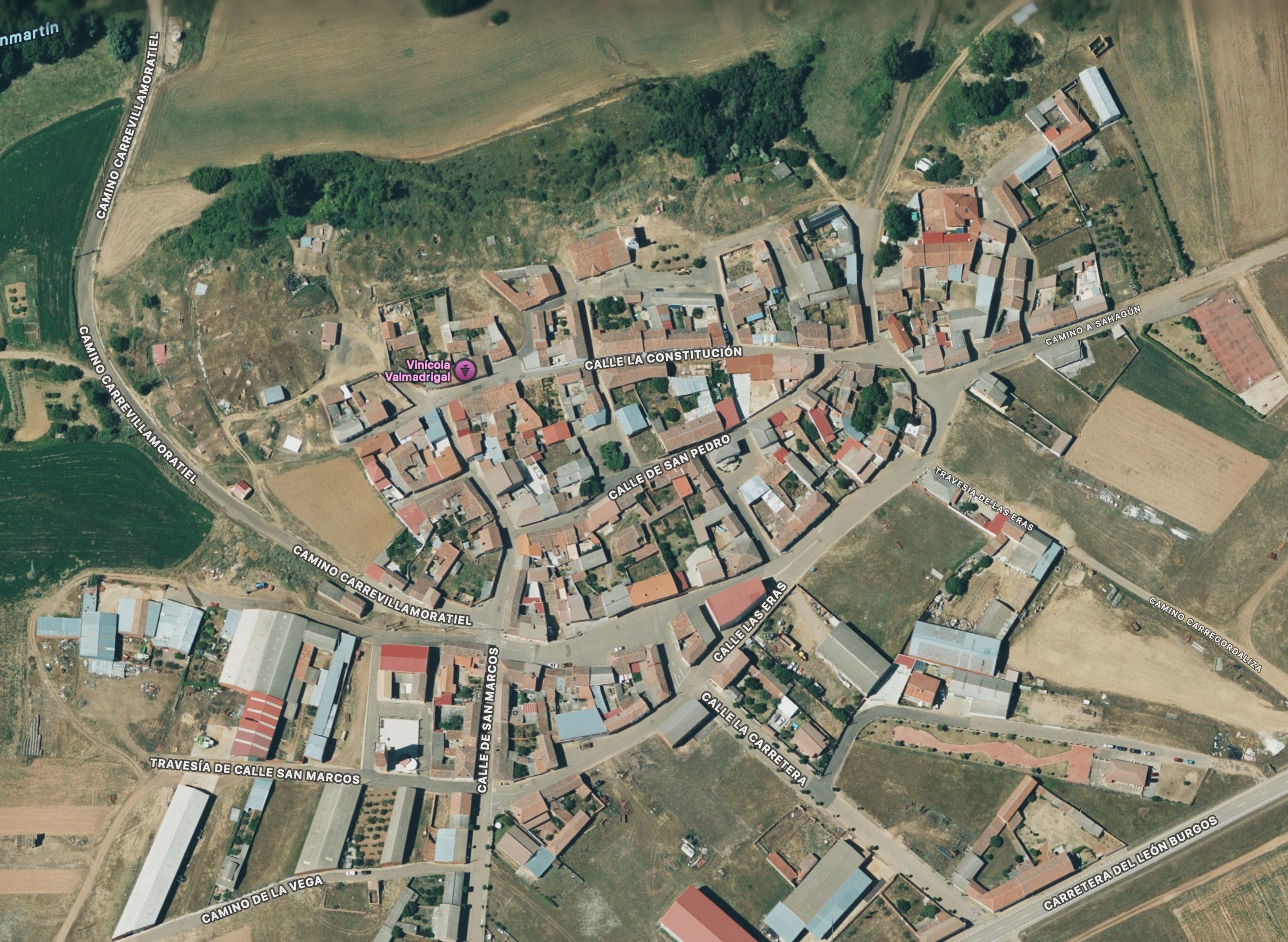
I go downstairs to break the news to Felisa but she’s waiting for me in the kitchen. Apparently she’s mixed up Gregorio with Gabino or Geronimo or someone else, and it wasn’t Castrotierra it was Vallecillo, she thinks. I curse her for messing up my story, and go back upstairs to the computer to find Valecillo, which is the next village along and looks exactly the same. I’m not even going to change the screenshot. That’s how it happened - first it was Castrotierra, but now she thinks its Vallecillo. In truth, both were involved.
Whichever it is, we’re going tomorrow, I decree. Felisa will make lentils for lunch and then we’ll all hit the road.
It’s raining pretty hard when we wake up and it’s not letting up as lunchtime approaches. We finish our lentils and Felisa lays down for a siesta as the rain starts to peter out and the clouds thin just a touch and I say we should go now before it starts to rain again.
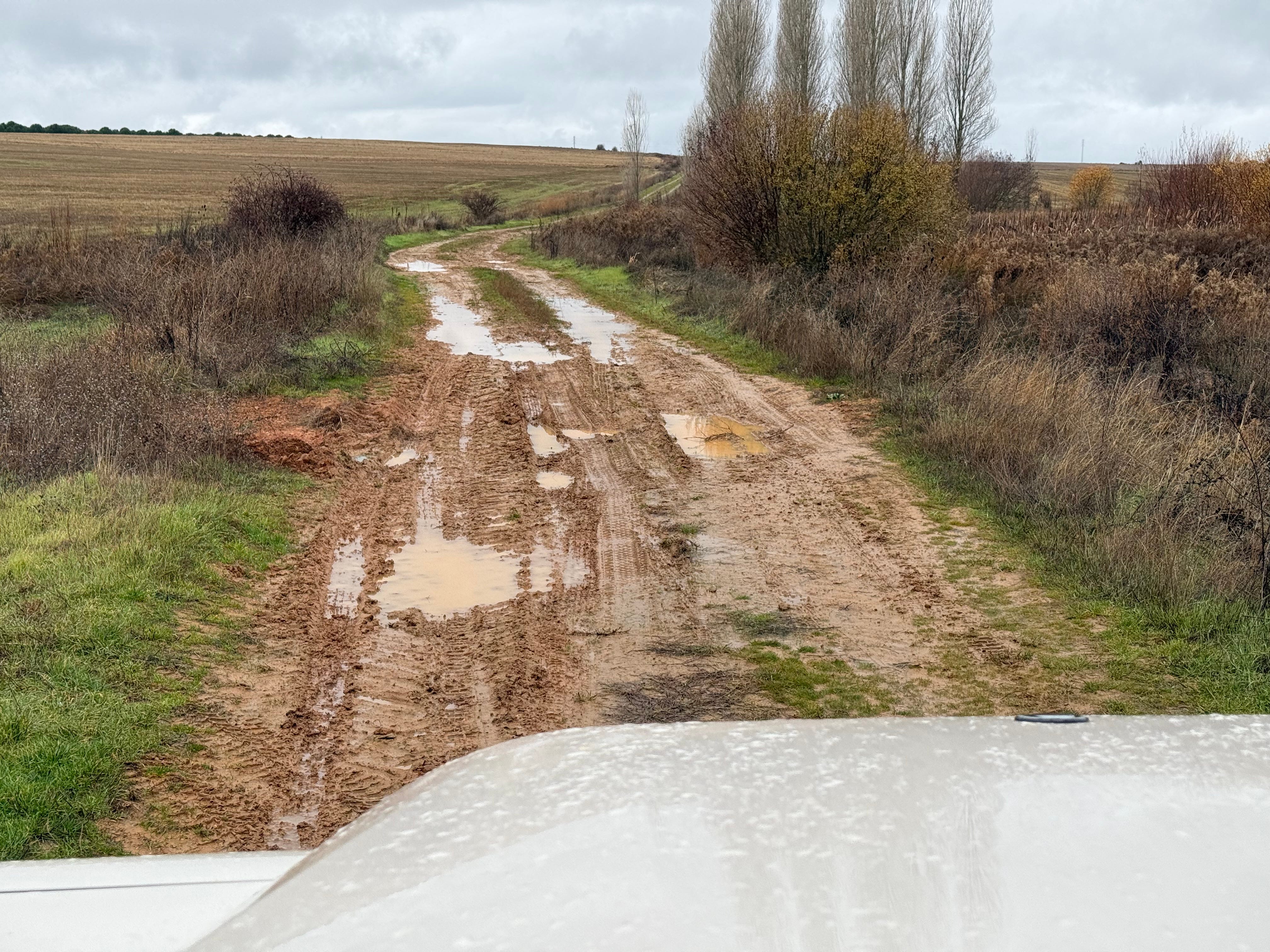
We’re going to do this properly. We’ll do our best to retrace Arturo’s original journey through the fields using only tractor paths, avoiding the new road that could get us there in all of 8 minutes. The mud is thick and slippery as hell this time of year, and with today’s downpour there’s no guarantee we’ll make it, even in the 4x4.
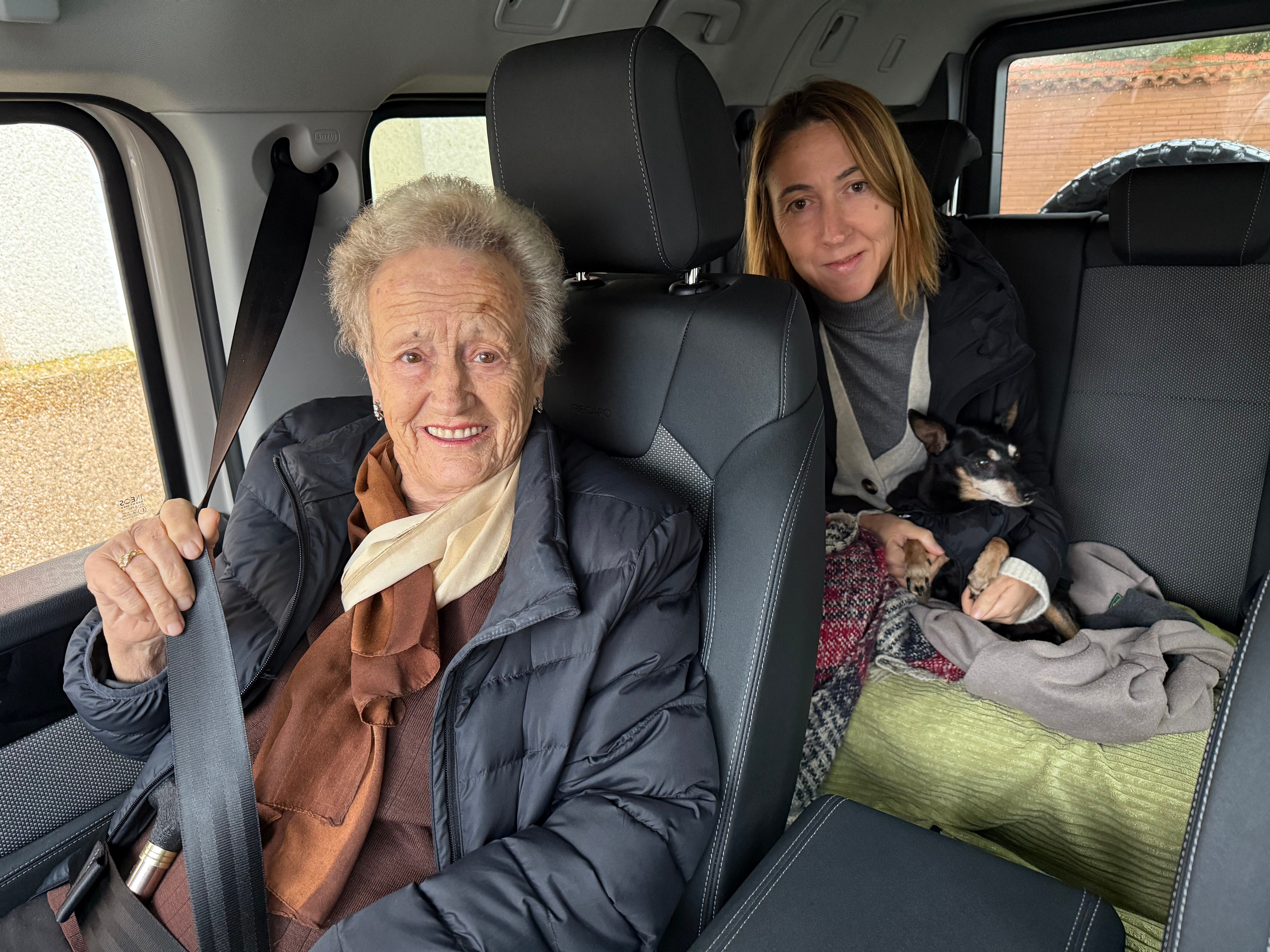
The GPS is off, but it’s in my pocket as a backup; with a 90 year-old and an indifferent miniature pinscher as co-pilots, I don’t rate our chances too highly. We set off down the same track Arturo would have taken 70 years ago, although today the scene is very different. In some ways this village has changed beyond recognition, but in other ways it’s exactly the same, but that’s for another day. Today the difference is meteorological. The plains of Castilla are a canvas painted by the hand of mother nature. In summer, the skies are impossibly blue, the fields are deep, golden yellow and extend into the infinite horizons, the tracks are dusty, hard and make for easy going.
On this drizzly and overcast December afternoon, the tracks are all but impassable. The 4x4 lurches from side to side as the back wheels spin and slip over the mud that’s been churned to a gooey pulp by the local farmers. The ditches get deeper and deeper and we’re all squealing like a bunch of schoolkids as we plough through. The water that comes up to at least the wheel arches sprays out in a brown fanfare as we pass, leaving the windscreen coated in an opaque film. As we head down into the last valley before the village, there’s practically a lake at the bottom of the hill before the track makes the final climb back up. We go for it, vowing not to come back this way.
Felisa is having a blast and is grinning from ear to ear as she recounts stories from every bush and rut along the way.
As we pull into the village, Felisa instantly loses all her confidence in her ability to identify Don Gregorio’s house. The first house we see looks almost identical to hers and we think it might be the one, but the location isn’t quite right, so we pull up to a garage where we find the only human left in the village. We must have been a sight to behold - four out-of-towners, a jeep caked from top to bottom in mud, asking for directions to the house of a 120-year-old doctor.
“He’s dead, you know?”. We tell him we’re just looking for the house, not the man himself, which instantly sounds suspicious. He thinks his wife knows which house it is and goes in to find out. He comes back out and points us to the beginning of the village, just off the main square. The square contains another three practically identical houses. Clearly Arturo wasn’t the only one who had been inspired to copy Don Gregorio’s design - this village was packed with clones. It takes Felisa a while, but she finally identifies Don Gregorio’s house, mostly from the roof and the steps leading up to the door. Sure enough, it’s a facsimile of her house, the house Arturo built. It’s been dressed up in a smart brick facade, but the design is basically identical.
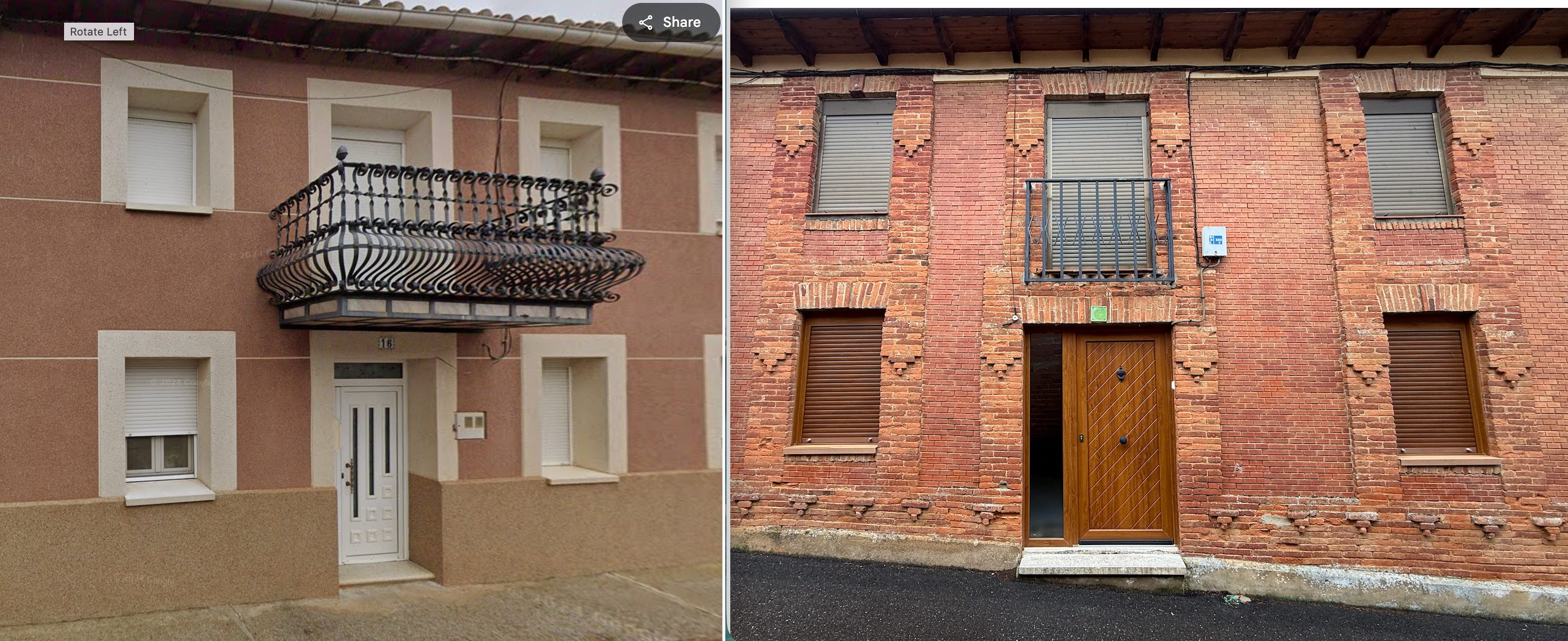
We felt pretty pleased with our afternoon’s detective work. Not only had we uncovered Felisa’s house’s lineage, but we’d also unwittingly solved the mystery of why there are at least 10 almost identical houses in Vallecillo that look significantly different to all the others. Rest in peace Don Gregorio.
Felisa and Arturo’s house has ceilings that are too high as well, but by now you understand that there was no architect involved in that outcome. Arturo wanted to place the house three blocks above street level to help evacuate rainwater and avoid the humidity gradually being sucked up the porous adobe walls. He’d already completed the main structure and started carting in earth to bring up the level when he realised how much work this would be and gave up on the idea. That’s how Arturo’s house ended up with high ceilings. No architecture degree, no CAD designs, no 3D projections, no Feng Shui. Just a man with a mule, a piece of string and a young girl who quite fancied him but was too shy to say. She’s still living here 70 years later, more than a decade after he’s passed, under these high ceilings, with her granddaughter, a strange Englishman and an indifferent miniature pinscher.
Rest in peace Arturo.
Just wonderful, adored every descriptive sentence!