

Is there a book you’ve read that left you with an uncomfortable feeling? Years, perhaps decades pass. You can barely remember any specific details, but every time you think about it, the feeling returns, somewhere deep inside, somewhere between bittersweet nostalgia and existential malaise? I have a few I can think of: Captain Corelli’s Mandolin and The Catcher in the Rye come to mind. Right now though, as the sun sits low on the horizon far across the cornfields to our left, I’m thinking about Zen and the Art of Motorcycle Maintenance and it’s hitting me hard.
Zen and the Art is one of those books that leaves you shellshocked. If you’re anything like me, you understood pretty much none of it, but somehow it left you jarred, not quite right. And right now I feel like Phaedrus, retracing my steps through a landscape I’ve known for twenty years, through an area I’m intimately familiar with, through a present that seems at once familiar but somehow receding and somehow declining, like this town, this countryside.
I feel like a time traveller.
One of the many joys that hiking has brought me is the experience of arriving in town on foot. Us urbanites don’t really do this any more - either we drive everywhere or there’s no discernible demarcation between one suburb and the next. Walking into a town or village is the exact opposite of touching down in a new city at night. Unless, perhaps, you sneak a peak out of the window and the night is clear, you’ll almost certainly land with little to no concept of the ‘emplacement’ of your destination: how it sits in relation to mountains, hills, rivers, roads, other towns, cities. It could be Bangkok or Boston, your body and senses are clueless either way. When you walk into a village, especially a tiny Castilian village where you can easily identify the last house, you cannot help but understand it. You subconsciously sense its relationship to the surrounding environment, the asphalt arteries that feed it, the subtle gradients that obscure it, then bring it into view as you slowly approach. You sense its presence as you approach. For the longest time you are an outsider and then suddenly, just like that, you’re in, and for the short but agreeable time, you are part of it.
As we come into San Pedro, about 6km into our hike, that feeling returns, but it’s mixed with something else. As we approach the church at the centre of the town, I know what it is. I’ve been here before. The holy building looks familiar. I see myself standing on the steps surrounded by people. Someone got married here. The Phaedrus feeling makes my hair stand on end. Hiking and deja-vu are a surprisingly potent cocktail. Jessi remembers: at the height of our career as wedding photographers (that’s to say, our third and penultimate gig) we shot M and V’s wedding right here. I remember yelling at someone’s grandma to get out of the group shot and then feeling instantly remorseful as she was comforted and ushered away by a grandchild, as I got the evil eye. That was over a decade ago now and we haven’t seen them since. The church hasn’t changed a bit; neither has the village really. A bit older, a few more ruins. Probably fewer people — hard to tell, we didn’t see anyone. In fact we didn’t see anyone at all for the duration of our three-hour hike.
Time travel is so easy here. It feels like cheating. Time just sort of stands still as you move through it, which means it’s moving backwards relative to you. Anyone familiar with rural, empty Spain must know this feeling.
As we press on towards Sahagun in the glow of an unseasonably warm December afternoon, Jessi catches site of a roadside building she recognises from her youth. In its heyday it was a thriving restaurant, she tells me; one of the best in the area. Every weekend in the Spring and Summer, families and friends congregated, weddings and christenings were celebrated, local wine flowed, laughter and music could be heard all the way up to the town. They even had their own bullring where the kids would chase after tame calfs while their parents knocked back cuba libres. Today it’s completely shuttered and the plaster is peeling from the faux-Roman arches that frame the entrance. The family’s second restaurant, in the centre of town, has also been shut for a year or two now. There’s just not enough people here to sustain it any more. The brothers have dispersed. Things aren’t going well for them.
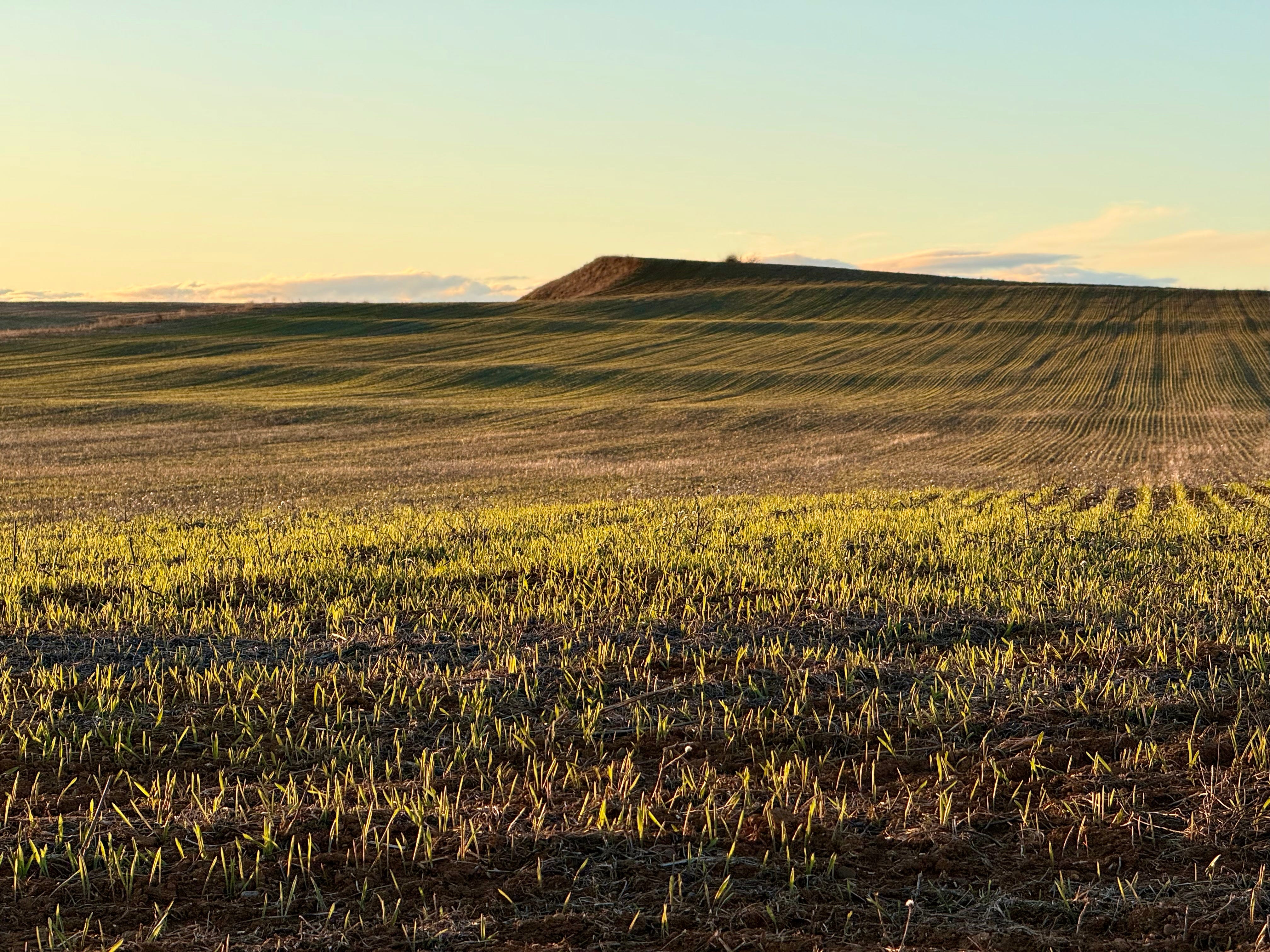
Another few kilometres and we begin the gentle climb up to the flat plain that will lead us into town. The sun is all but set now and the tiny, isolated sprigs of wheat that have managed to push through the sodden ground are outlined in a million little halos. Subtle irregularities in an otherwise endlessly monotone landscape are thrown into shadow moments before the gold turns to dusty pink and the landscape returns to a featureless beige canvas as far as the eye can see.
I’m not really looking though.
I’m thinking about the restaurant. I’m thinking about Sahagun in its heyday. When I first came here, almost 20 years ago, the nightlife was epic, even by London standards. Now there is nothing. The town is a shell of what it was just two short decades ago. But you know what really bugs me? I try to explain to Jess but fail dismally. It’s too deep for a mid-hike monologue. I think I’d feel sort of OK about it, this whole rural decline thing, the España Vacia (empty Spain) if it was clear that it was leading somewhere, like if I felt that the future was some shining digital phoenix which would rise in place of these crumbling adobe ruins. The way I’ve always thought about it until this year. Change felt directional, meaningful: generations of young Spanish destined to escape rural poverty for better lives in Madrid, London, Berlin, San Francisco. The whole thing made sense until AI came along.
But now it doesn’t any more. If I could get my time travel on and jump forward another two decades, I don’t see the grandparents of these paisanos gracing the keyboards of Google or Meta. Barely any keyboard jockeys will be needed just two or three years from now, the way things are going, let alone two decades. The thought chills me and makes me angry. Rural Spain has paid the ultimate price for industrialisation and digitalisation - whole villages, whole communities lost to the hope of a prosperous future, and more disappearing each year. Ever fewer schools, doctors, shops.
Fibre optic internet arrived in our village two years ago, just around the same time as ChatGPT. The former heralded the arrival of digital prosperity, the latter the end.
That’s it. Nothing much really. Nothing that makes sense anyway. Just the feeling that walking through these semi-abandoned villages, finding myself in places I visited in what feels like another life, hearing Jess talk about a vibrant rural past, seeing the decay unfold in front of my eyes, makes me feel like a time traveler. I’m just not sure any more whether I’m travelling forwards or backwards?
Love this, nostalgia, bittersweet and melancholy with beautiful descriptions- I was there!!