

After dinner conversation in Spain often gets out of hand. Perhaps it’s because it happens so late everybody is delusional from tiredness, I don’t know, but a lot of stupid shit gets said.
Like tonight Ana recounted the story about her bandaging Rodrigo’s ears to his head when he was a baby so they wouldn’t stick out and then somehow they were suddenly talking about the shapes of people’s heads. Apparently us men are unlucky because we can’t hide the shapes of our heads, what with the bald n’all that. A woman on the other hand can have the weirdest shaped head and you’d never know with their long hair. So if you’re a guy with an odd shaped head, you’re out of luck. We all lamented the shapes of our own heads. Mine is too round, I said. Rodrigo’s is like a ‘pepinillo’ (gherkin) according to Susana.
And then, this being the village, they started on the shapes of the heads of everyone else in the village. “Mariano has a big head”, says Feli. “Yes, too big for his body”, Ana agrees. “He was always like that, even as a little kid”, nods Feli, sympathetically. Ana remembers. They rattle through the rest of the village, one by one. Every poor sod here has something wrong with the shape of their head according to these guys. They make it sould like a troglodyte village.
I’m flabbergasted they have such perfect recall of the shapes of 150 other heads, but it makes sense when you think about it. When you see the same 150 people almost exclusively, day after day, year after year, you probably do get the shape of their head indelibly imprinted on your brain. Perhaps the human brain is especially good at head shapes when absorbed in reasonable, village-size numbers. Perhaps city dwellers develop ‘Headshape Blindness’ from overexposure to other people’s head outlines. They all melt into one. I don’t believe I’ve ever paid the slightest bit of attention to the shape of anyone’s head, so I clearly have a long way to go. I can just about differentiate a human from a cow.
In general, they do know a lot about each other here. Too much. I guess that’s just the way it works. Feli has a comprehensive mental database of the gastronomical likes and dislikes of everyone that lives within a 200m radius, which is to say, the whole village. She’ll see a food and go ‘capers, oh yeah, Jorge loves them, but Julio’s not so keen and Anita’s husband got one stuck in his ear in 1952 and it got infected and he partially lost his hearing’, pointing at her ear and winking. This is unsurprising given it’s mostly all they talk about at mealtimes. They start with a food, say, mayonnaise, which Ricardo doesn’t like but Alberto does, but oh doesn’t Alberto really dislike fried liver, oh yeah he does but Pedrito really loves fried liver doesn’t he? And like this they go on for hours, looping through every conceivable foodstuff and 4 generations of 8 families. It’s like a mental training exercise for the most demanding memory game you can think of. I sometimes suggest we bring a whiteboard to dinner, because I quickly lose track of who dislikes sardines and whose favourite dish is garlic soup.
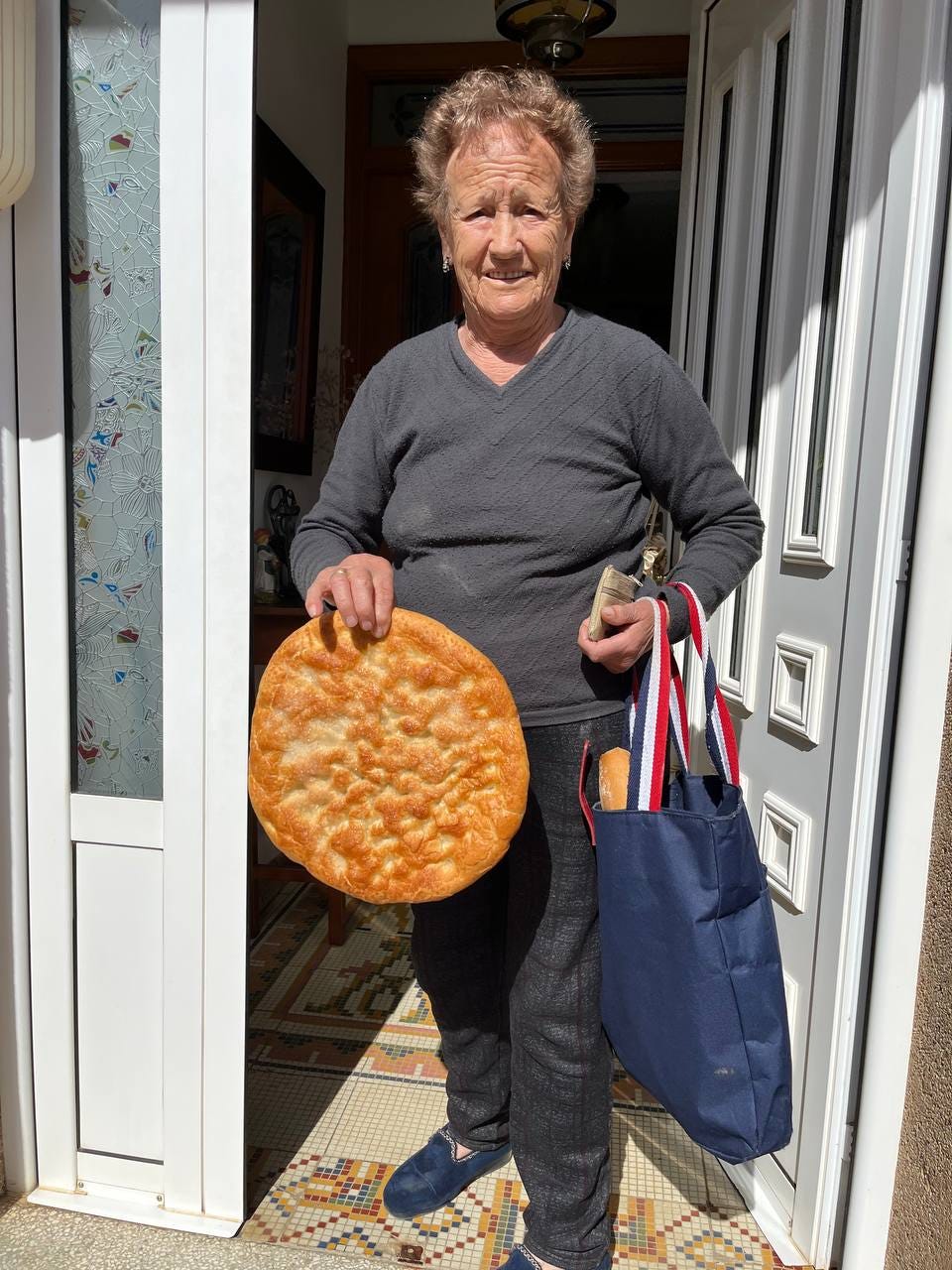
The service at the village shop is so slow and public that they all know what everyone buys anyway, so there’s not exactly any hiding your preferences. Go to the store and buy an avocado and you’ll be the talk of the town for three sunsets. Your legend will probably outlive you. You’ll be the guy who dared to ask for ‘aguacate’. If I’m around the village and need to know if Feli has gone and bought the bread yet, I don’t have to call her to ask. I can just ask anyone in the village. Yes, this is normal. I can literally just go up to someone in the street (rare, at this time of year) and ask ‘Has Feli gone for bread yet?’ and this person will almost certainly know the answer. News spreads fast in this village. There are no secrets. When you get in your car and drive off, 4 or 5 sets of curtains gradually part for a few seconds. “They went off about 6”, people will say over dinner. “Wonder where they went”. And this conversation may last 10 minutes or longer. When someone asks “how are you?” here, they’re taking notes.
Thankfully their ‘curiosity’ is topped only by their unrivalled capacity for gossip otherwise all this precious information would be lost, but luckily anything known by one person in the village is known by the whole village before you get home from the shop. It’s the rural version of social media. Anyway, gossiping is quite evidently what humans do in the wild, right? We evolved this compulsion to social narrative construction which bound us together more tightly into cooperative bands, doesn’t the story go? To gossip is to keep your social brain well oiled and efficient, which might go some way to explaining why the octogenarians around here are so on the ball.
This all sounds quite cute, but there’s a dark side to it too. I’ve always hated ‘persianas’ in Spain, especially in the village. These roller blinds, installed on every window on every house, produce the distinctive rhythmic clattering that forms the soundtrack of every pueblo, barrio and residential street in Spain. I’ve never understood why they bother, to be honest, since they’re just always closed, or cracked open 3cm at most. They open them for a few minutes in the morning, shake out a rug and air the room, then close them again. In the summer, it’s because it’s too hot and you can’t dare let the sun in. In the winter it’s because it’s too cold and you can’t dare leave the window exposed. This is why every Castilian village always looks like a ghost town when you drive through, unless its exactly 7pm and the zombie hordes are out for their cholesterol walk. Anyway, I quite recently discovered that the true role of ‘persianas’ probably has less to do with the weather and more to do with the desire to keep out prying eyes - a throwback to the civil war era when even close neighbours were pitted against each other and were thus keen to keep their secrets behind closed doors and windows.
When we tell people that we won’t be putting shutters on our new house, they don’t ask about energy efficiency, they say “but people will see everything you do”. I suppose they will, but I guess this is what you sign up for when you sign up for this village. Everyone will soon know about my round head, and whether I like (gasp) green pepper in my tortilla, and if I’ve been to the shop for bread yet and what time I go to bed. They’ll talk about it at family get togethers. Maybe weddings. In time, I too will probably be able to identify all my neighbours by the silhouette of their skull and likewise know which of them buys ready meals and doesn’t like goat cheese. I wonder what city knowledge will be squeezed out of my brain by this new delicate social tapestry I’m going to have to hold in working memory.
Until next time. And be careful where you put capers.